


(images from The Subwoofer DIY Page)
This semester I set out to create a portable musical instrument to promote unstructured jamming and encourage public discussion. I began with the assumption that the instrument would be small and electronically sophisticated, possibly based on a cell phone or mp3 player. Although the latest cell phones can produce musical tones and samples of sound, they do not have a pleasant sound. I started research on loudspeakers with the intent to improve the sound of a portable device.
The website, Audio Asylum was one of my first sources of information about loudspeakers, specifically the High Efficiency Speakers forum. I was interested in high efficiency because portable devices must have a limited power consumption. The forums on Audio Asylum are a rich source of links to other websites. One website with a great explanation of different types of speakers is The Subwoofer DIY Page.
High efficiency subwoofers are interesting because if a cell phone is to be used as a musical instrument, it is missing the ability to create lower frequency tones.
Above are four schematics of different subwoofer alignments from The Subwoofer DIY Page. Breifly, the relative advantages are as follows:
Sealed: The cabinet volume is the primary factor determining
performance. Larger cabinets are required for lower notes.
Ported: Ported speakers have improved bass response down to
a frequency determined by the volume of the box and the volume of the port.
The air in the cabinet and the mass of the air in the port form a resonant system
that can be thought of as a spring-mass system. This is one of the most popular
speaker designs.
Transmission Line: A tube, or line, usually folded within the
cabinet, extends behind the speaker. The length of the line is one quarter wavelength
of the resonant frequency of the driver. This design must be larger to go lower,
but it provides high fidelity bass response.
Fourth Order Bandpass: Similar to a sealed enclosure, but with
better power handling. Commonly used for home theater subwoofers where high
power can bring more sound out of a small enclosure. This design is larger than
a similar sealed design, but is able to use more power. A drawback is the limited
frequency range that can be produced.

A horn speaker produces more sound from a given electrical input by improving the interface between the vibrating diaphragm and the air. The disadvantage of a horn speaker is that in order to produce low frequency sound, a large horn is required. The human voice has a frequency range that can be amplified by a familiar horn speaker- 'bull horn' or 'megaphone' type speakers are examples.
Bass horn speakers are only familiar in large concert settings, though they are not easy to recognize. They allow touring bands to carry enough sound reinforcement to produce the low frequency sound that dominates today's popular music

In the spirit of independent media, I looked at bands without tour busses. Bands in small venues playing acoustically can benefit from improved low-end, the bass you feel. The heart of a band is the drummer, and the heart of the drum set is the bass drum. I set out to see if a bass-horn could be used to improve the bass drum. I reasoned that it should be possible to replace the driver in a speaker with a drum head, and to use the technology of loudspeakers to improve the sound of an acoustic drum.
My search for drums using speaker technology turned up only one- the X-Drum, produced by the X-Drum company based in South Carolina. This drum, and it's smaller version- the Kick-Box, use tuned ports to improve the sound of a conventional bass drum. These drums are constructed from heavy wood, similar to a speaker cabinet. The X-Drum has two drum heads and four tuned ports. The Kick-Box has only one drum head, and one port. The Kick-Box operates in a manner that is more consistent with my conception of a drum based on speaker technology.
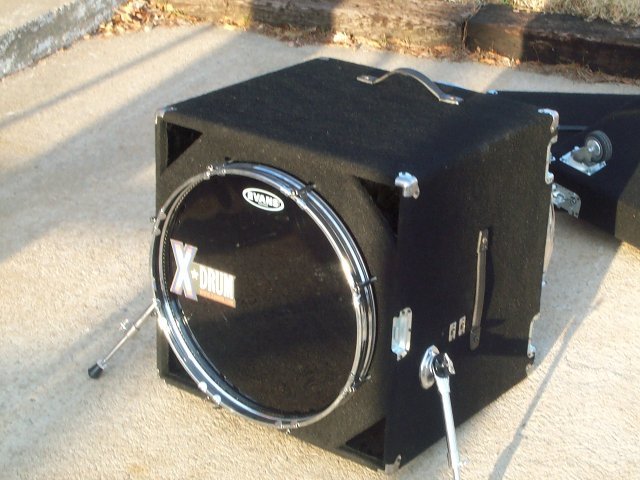


It could be that X-Drum has already got best idea for using speaker technology in a drum. Futureman from Grammy award winning Bela Fleck and the Flecktones uses both the X-drum and the Kick-Box, so they must be doing something right. From my discussions with Mike Kelley of X-Drum, they have not tried a horn-based drum, and most of the current design has been done by trial and error.
I am currently investigating the possibility of a horn based bass drum, and I am studying the current designs to see if they can be further optimized. X-Drum is also interested in a device based on the current technology to allow conventional bass drums to be converted.