Starting at the end of December, I started working with Neil Sotirokopolous
to bring special effects to the independent film outfit, SAS
Films. We discusses several devices for time lapse camera control, a custom
dolly, and a follow-rig for getting smooth footage following a skiier down a
hill, but all of these devices would cost enough just for materials that commercially
available solutions were attractive. We identified one expensive special effect
that could be reproduced cheaply, and that effect is bullet-time.
Interview with Neil Sotirokopolous of SAS Films here.
Trailer for his upcoming movie, Wicked (13.4 mb)
Bullet-time is the term for the slow motion effect with dynamic camera motion made famous by The Matrix, a Warner Brothers film with a $60 million budget. Bullet time allows film makers to show action shots from many angles in dramatic slow motion. This effect is expensive to achieve, and to date has only appeared in one ski video.
The goal of this project is to produce a fully functional bullet time camera rig for less than $500. The rig must be reusable, either accepting disposable cameras, or using conventional film. Conventional film is preferrable because it is possible to use high speed film. A rig with 30 cameras needs to fit into a VW Rabbit.
The primary challenge in this project was to find a method of triggering inexpensive cameras at a specific point in time. Cameras under $10 generally have a mechanical shutter and no remote triggering capability. Electronic shutters would allow remote triggering with some rewiring of the camera, but since cameras in the price range do not have this, I had to find a way to mechanically push the buttons. Pneumatic, hydraulic, and mechanical methods of distributing the motive force to the buttons due to requirements for time resolution. An electromechanical solution seemed like the best way to push the buttons, but olenoids cost too much to consider.
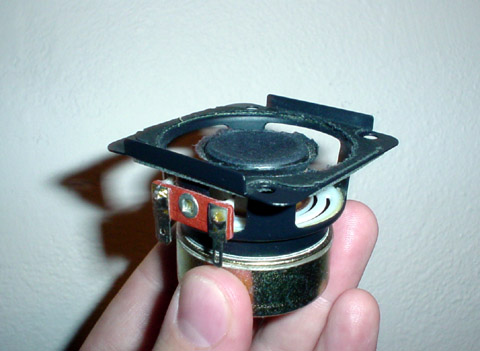
Parts Express carries a 2 inch full-range speaker with a maximum one way excursion of 1 mm. This driver weighs less than half a pound, and costs 87 cents each. By removing the cloth surround, I was able to increase the excursion to several millimeters with more than enough force to press the button on a camera.
I used Solidworks to visualize the to assembly that would be required to hold and allign the driver with the camera's button, and found a configuration that would allow us to use a simple shape of constant thickness high density fiber board to allign the camera, driver, and push-rod, and to hold the assembly on a stand.
CAD prototype of driver with disposable camera:

Neil located an extraordinarily inexpensive manual 35mm camera at a google.com shop, and purchased 30 of them for just over $3.50 each.
Final Assembly:
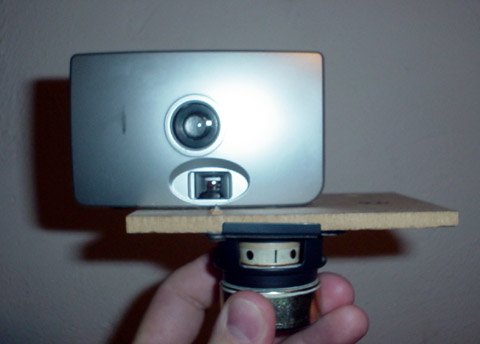
Rear view:
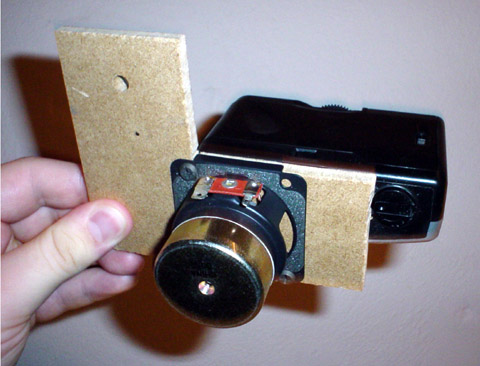
In order to test the effect of special effects on independent media, I have designed an built a low budget version of a big budget hollywood effect. The prototype was successful, and shots will be used in a film.
This system has been field tested at a video shoot at Mount Snow, and nothing
broke. We are still waiting to develop 30 rolls of film. It would be possible
to develop and scan the negatives ourself to save more money, but Neil knows
where he can get them developed to CDs instead of prints.
A test video shot with a digital camera to show the approximate bullet time
effect at half the radius of the final rig is available for download here:
Test video (791 kb)